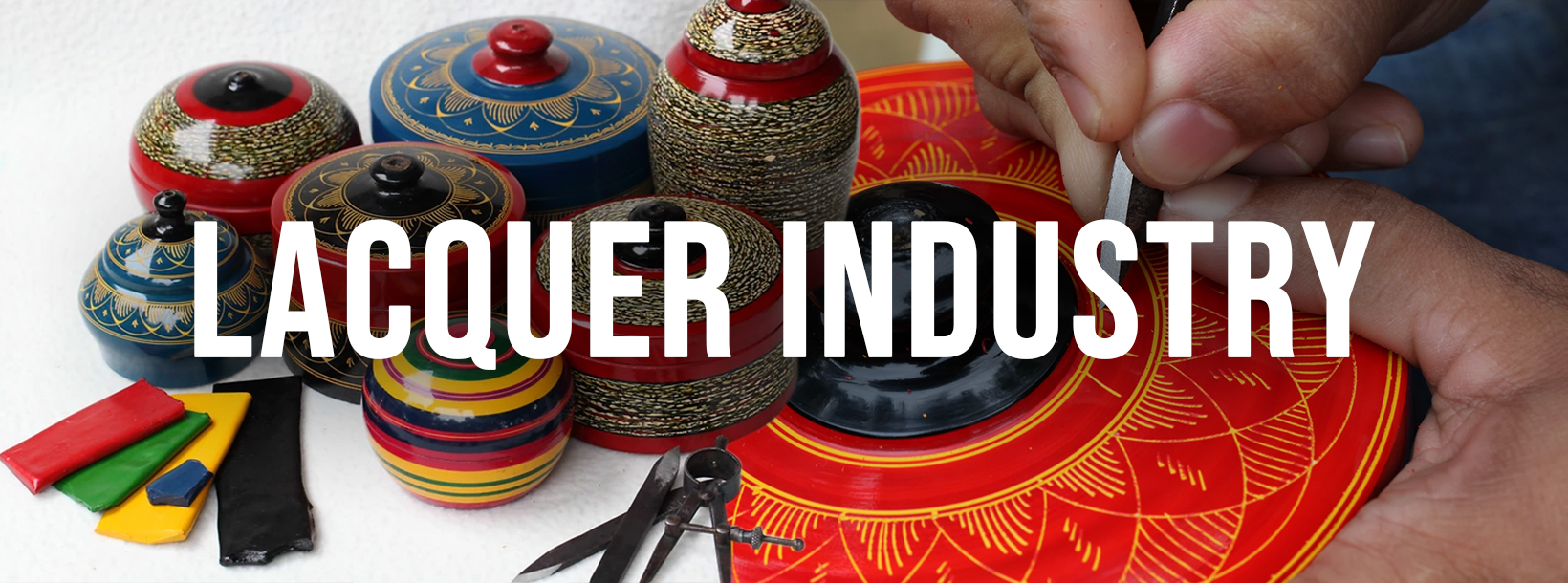
The lacquer industry sees its roots in the earliest period of history accounted for by the inscriptions and historical manuscripts of Sri Lanka. Known more commonly among locals as laksha, this line of art sees to intricate designs sketched upon utensils, vases, candle stands, ash trays, and ornaments with religious value; Buddha statues, sesath poles, and replicas of Buddhist shrines.
The word “laksha” is derived from the local name of the insect whose larvae are used in making the substance that serves purpose of drawing ink in the industry. For colour, traditionally laksha would be mixed in with naturally obtained pigments to produce the primary hues of red, black and yellow. With the advancement of technology, artificial dyes have now come into use, and see to enhancing the vibrancy of lacquer products by use of more shades in the artwork.
There are two basic techniques in this industry; namely lathe work and nail work. The former of the two, also known as “pattal wada” or spool work, refers to the involvement of a lathe upon which the object is rotated, a hardened stick of lac manoeuvred as drawing material. The friction generated by this rotation softens the lac, hence used to draw upon the surface. The technique named nail work requires both skill and patience. Firstly, the object is coated with the desired ground colour, warmed in the heat of fire. A layer of lac is pressed onto it, smoothened out by a talipot leaf. The artwork is then designed by plucking the lac out by nail of the thumb, and then polished with a talipot leaf soaked in coconut oil.
However much significance brought unto this industry in terms of culture and heritage, there is but a limited number of artisans within the country who possess the knowledge and the skill required to continue with it. It is more a family tradition now, in that aspect, but one preserved with utmost pride, since it brings definition to Sri Lankan tradition as a whole. Hence lacquer craftsmanship receives much admiration even within the local community, often provided prominence in the business of handicrafts and artistry.
You can purchase your own lacquer products here– by following through to our souvenirs section. Once there, you will be find handicrafts and traditional Sri Lankan trinkets that serve purpose not just as keepsake, memento, but also add to your household a sense of aesthetic and ardour that really is like no other.